Deep Dive – August 2025


Deep Dive Topic – Crypto

In the past, I have written about some esoteric topics that I have found to be interesting and to help our clients gain perspective of how the world is changing to further our knowledge base. Todays topic is Crypto and I do hope you enjoy this and as always, any questions or comments please reach out.

The Internet or World Wide Web as we all know it today was born in 1989, although there were earlier versions in the years prior. One way to think about the internet is as a digital pipe of access to information. This pipe, however, did not have any payment or authentication system built into it from one person to another. Today, you might consider Crypto in general and Ethereum as a digital payment system being built into the internet or a layer within the internet.

What is Bitcoin? It’s a technology that is limited to 21 million Bitcoins and was developed in 2008, started being used in 2009 and the “inventor” was someone by the name/pseudonym of Satoshi Nakamoto. This vison was based on a free market, peer to peer payment system free from government or other ownership entities. Many consider Bitcoin as digital gold due to the limits on how many Bitcoin Tokens can be developed.

What is Ethereum or Ether? Developed 2015, it’s a decentralized payment system built with contracts and applications that never shut down. It runs 24 hours per day, 7 days a week. Ether is like a toll both collecting fees from its network of contracts or applications.

There are many, many, many Alt Coins or other forms of cryptocurrency, but we will not address these in this article. However, it’s important to note that as of August 2025, Bitcoin has a market cap of about 2.3 trillion and Ethereum has a Market Cap of about 550 billion. According to Tom Lee of Fundstrat, there has never been an asset in our History with a Market cap of 2 trillion and failed or went away, so this technology should be around for a long while.

With this, lets look at some recent legislation from the US Government, and more recently a speech given by Paul Atkins, Chairman of the United State Security and Exchange Commission (SEC). This speech was given on July 31, 2025, at the America First Policy Institute in Washington, DC with a title given of American Leadership in the Digital Finance Revolution.

The full transcript is here

Evolution of Capital Markets: From Buttonwood to Blockchain

The winds of innovation have always swept through our capital markets, often at gale force. In 1792, they rustled the leaves of a buttonwood tree, beneath which two dozen stockbrokers assembled to establish the forerunner to the New York Stock Exchange. That modest agreement—fewer than a hundred words handwritten on a slip of parchment—set in motion an elegant design that would govern the flow of capital for generations.[2]

In the centuries since, our markets have never stood still. They have expanded, evolved, and reinvented themselves in step with the ideas and technologies of their time. Markets are dynamic because of the people who participate in them. Markets channel human ingenuity toward society’s most intractable problems by rewarding those who develop the most innovative solutions that others value enough to buy. They are the mechanism by which Adam Smith’s invisible hand elevates those who act in the common good—even when pursuing their own.

Adam Smith was a Scottish philosopher and economist from the 1700’s and his book The Wealth of Nations has been considered highly influential in the study of economics since.

The SEC’s role is to safeguard markets that allow the spark of human creativity and skill to benefit society. Over the arc of its history, the agency has both enabled innovation and, regrettably at times, stifled it. Fortunately, progress has a way of prevailing. And when our regulatory posture is calibrated to meet innovation with thoughtfulness rather than fear, America’s leadership position has only grown stronger.

In the 1960s, Wall Street was riding a bull market. But behind the scenes, our market machinery was straining to keep up. Most clearing and settlement transactions involved a costly and cumbersome process. Rising stacks of paper stock certificates had to be physically delivered by clerks wheeling carts up and down Wall Street and in other financial districts all across America.[3] It was a scene from another century struggling to meet the demands of the modern securities markets.

Indeed, the paper-based clearance and settlement systems, built for a gentler era, began to buckle under the weight of soaring volumes. Delays at one firm held up the work of another. Securities were lost or stolen. Fails ballooned. And many thinly capitalized broker-dealers were caught by the whiplash of scuttled transactions. In desperation, trading hours were reduced and exchanges eventually closed on Wednesdays to allow firms to process the mountains of certificates.

The breakdown over an antiquated system was described by the SEC chairman at the time as “the most prolonged and severe crisis in the securities industry in 40 years… Firms failed. Investor confidence plummeted.” And very much to its credit, the SEC was proactive in remedying the so-called “Paperwork Crisis.” The agency helped market participants to develop the Depository Trust and Clearing Corporation, which would transform how securities were held and traded.[4] Instead of shuffling paper certificates from customer to broker, broker to broker, and broker to customer, title to shares could now be transferred through computerized ledger entries.[5] The certificates themselves were immobilized, stored securely in vaults, as ownership moved electronically, laying the foundation for the modern clearing and settlement system that has continued to this day.

I have underlined a couple of sentences above noting its significance towards evolving technology, the removal of friction from transactions and in the process lowering of costs for the clients.

So, this brings me to today. To a moment that demands American ambition. To a project that can unleash it.

Our regulatory framework need not be anchored to an analog past—unkind to new frontiers. After all, the future is arriving at full speed—and the world is not waiting. America must do more than just keep pace with the digital asset revolution. We must drive it.

So today, I would like the world to go on notice that under my leadership, the SEC will not stand idly by and watch innovations develop overseas while our capital markets remain stagnant. To achieve President Trump’s vision of making America the crypto capital of the world, the SEC must holistically consider the potential benefits and risks of moving our markets from an off-chain environment to an on-chain one.

We are at the threshold of a new era in the history of our markets. As I mentioned earlier, today I am announcing the launch of “Project Crypto”—a Commission-wide initiative to modernize the securities rules and regulations to enable America’s financial markets to move on-chain.

There are a couple of very bold statements above, statements that are fully anchored in Digital Block Chain/Crypto within our financial system.

In addition to the SEC’s action and their Commission Wide Initiative Project Crypto, United States Congress recently passed the GENIUS Act (Guiding and Establishing National Innovation for US Stable coins) and The CLARITY Act (Digital Asset market Clarity Act)

GENIUS Act: This bill establishes a regulatory framework for stable coins, which are cryptocurrencies designed to maintain a stable value by being backed by US Treasury Bonds. With this, Treasury Secretary Scott Bessent believes that these Stable Coins could potentially be backed by about 3 trillion in Treasury Bonds as this market develops. It might be helpful to think of these assets as a lower cost way of making transactions anywhere in the world, 24 hours per day, 7 days per week- a little easier for Government or corporations to move money around the world.

CLARITY Act: This bill focuses on providing Regulation Clarity to the entities who will oversee Digital Assets like the SEC or Commodity Futures Trading Commission.

Both Acts were signed into law July 2025.

Since these Act’s passed, a recent article on CNBC outlines plans by Goldman Sachs and BNY Mellon to move over 7 Trillion of Money Market Funds onto this Blockchain technology,

This is the first of many changes to come, over the years we should start to see Stocks, Bonds, Real Estate, Titles to Cars, Boats etc. all move to blockchain for transactions and authentication.

With all of this, it seems we are back at a place like the 1960’s where there was transformation of stock trading from paper to digital stock holding, know we are on to the next transformation change that will drive innovation and have a natural deflationary force to drive down costs and increase efficiency. 

Thank you for reading.

Deep Dive – August 2024

Clients and friends. We hope your summer is going well and you have been able to spend time with family and friends connecting and doing what you enjoy. We got to spend some time in San Diego while on a business/family trip in early August. It was a great opportunity to come together with other leaders in the financial industry to learn about topics such as AI and robotics and how they are integrating into society. We also got to spend time on some of the areas beautiful beaches. The kids voted the dog park beach as their favorite. Happy dogs and a stunning sunset. A great combo. 

Artificial Intelligence & Robotics

With so much discussion on Artificial Intelligence, (AI) I wanted to share a deep dive on this topic for late summer as we will all be hearing more about AI advancing and more on this topic of advanced Robotics.

Why is AI and Robotics such a hot topic?

According to Fundstrat’s Tom Lee, the number of “prime workers aged 18-55 has shrunk relative to the size of the total population. This occurs during demographic cycles which is driven by advancing modern medicine and increased longevity through healthy lifestyles which results in an aging population. Lee estimates that the cycle started around 2016 and will run until about 2036, leading to a shortage of about 40 million prime age workers worldwide at its peak.

This worker shortage is why corporations typically invest in productive technology. Lee expects this worker shortage to result in an estimated salary loss of 3 trillion dollars. Thus, the investment into technology like AI would act as an offset to wages lost due to lack of workers.

The Evolution of AI and Large Language Models

AI had its start in the 1950s, and has made incremental steps forward in the following decades, making significant strides which have lead us into the era of OpenAI’s ChatGPT (2022), Google’s Bard (2023) and others since. These Large Language Models (LLM) use deep learning techniques to understand and generate human language, allowing for a wide range of applications – from chatbots to content generation and beyond.

Are there different Levels of AI capabilities? Yes:

  • Narrow AI: This is where we are now, current LLMs are examples of narrow AI which are designed to perform specific tasks without general intelligence. They excel in language tasks but do not possess the ability to understand the world as humans do.
  • General AI: Ray Kurzweil a noted futurist and others predict that the next several years could see significant advancements towards artificial general intelligence (AGI), where AIs would have cognitive capabilities comparable to humans. In one of the videos below this is demonstrated. This could allow LLMs to engage in more nuanced conversations and perform complex problem-solving across diverse domains.
  • Superintelligent AI: It is being predicted that in the decade following this period of General AI advancement, we could potentially see superintelligent AI, capable of surpassing human intelligence in virtually all respects.

The Role of Training Data

The effectiveness of LLMs depends heavily on the amount and quality of training data. As more data becomes available, models are expected to become increasingly sophisticated, with improved contextual understanding and better handling of ambiguity and complexity in language. This is the area that entails computer data centers which require large amounts of computing power and thus, large amounts of energy to run.

Some typical use cases of AI that we all use often are, Chatbots on websites, Maps on your Mobile Phone, SIRI or Alexa via home speakers. Drive through fast food companies are beginning to use this technology to automate customer service. Tesla uses their proprietary AI system for their cars that use Full Self Driving (FSD) and they have noted that this feature has a positive impact, based on vehicle safety report 2022 data which shows vehicles typically are in accidents every 1.4 million miles, and with Tesla FSD have an accident about every 4.8 million miles- massive improvement.

How else is AI (software) making the next big connection to Hardware?

Institutions like Massachusetts Institute of Technology (MIT) have a long history of paving the way in cutting edge research, and this new era of AI and Robotics has been no exception.

MIT’s educational programs typically combine computer science, cognitive science, and engineering, preparing students to tackle the challenges presented by AI systems.

The research projects at MIT for advancing the capability of AI and Robotics are split between program disciplines. MIT Media Lab works on projects that explore human-AI collaboration, while the Computer Science and Artificial Intelligence Laboratory (CSAIL) delves into machine learning and robotics innovation.

MIT’s emphasis on robotics is essential, as it provides a bridge between AI software capabilities and physical applications. Research into robot perception, manipulation, and navigation hinges on AI advancements. As robots become more intelligent, they can be applied across various industries, from manufacturing to healthcare.

MIT also builds in Ethical and Safety standards into their program which is a massive consideration and hot topic that the field at large will need to grapple with. Government will also wrestle with this topic through regulation.

Boston Dynamics and the Future of Robotics

Boston Dynamics, known for its cutting-edge robotics, has transformed the landscape of physical automation. The company’s robots, such as Spot and Atlas, are celebrated for their agility, dexterity, and advanced AI capabilities, reflecting the direction that robotics may take in the coming years.

  • Advanced Mobility and Manipulation: Boston Dynamics creates robots that can navigate challenging environments autonomously. In the next six years, we can expect further enhancements in AI-powered perception, allowing robots to perform complex tasks in dynamic and unpredictable settings.
  • Collaboration with AI: Boston Dynamics is increasingly integrating AI into its robots, which will enable them to understand their environments more intuitively and make decisions on-the-fly. This integration could revolutionize industries such as construction, logistics, and delivery, where robots assist humans and perform tasks that are too dangerous or tedious.
  • Human-Robot Interaction: As robots become more prevalent, understanding how these machines can collaborate with humans will be crucial. Future developments may focus on creating more effective and safe interactions between humans and robots, leading to better integration in workplaces and everyday life.

The Future of AI and Robotics: 2030

As we project forward six years, several trends and implications can be anticipated in the fields of AI and robotics:

AI technologies will likely become embedded in everyday tools and applications, enhancing productivity across various sectors. From personalized learning systems to AI-driven healthcare diagnostics, the impact on efficiency and decision-making will be everlasting.

As AI becomes more integrated into society, there will be a pressing need for clear regulations to ensure ethical use. The issues of bias, privacy, and accountability will be at the forefront, requiring collaboration between technologists, legislators, and ethicists.

AI and robotics will transform job landscapes. While certain jobs may be displaced, new roles focused on AI oversight, robotics maintenance, and collaboration will emerge. Education and retraining will be necessary to prepare the workforce for this transition.

AI capabilities will play a significant role in addressing global challenges such as climate change, public health, and food security. The ability to analyze large amounts of data and model complex systems could lead to innovative solutions for these challenging areas we are living in.

Philosophical and Existential Considerations: The rise of AI will force society to confront philosophical questions about consciousness, intelligence, and the role of machines in human life. As AI approaches human-level intelligence, discussions around rights, ethics, and the future of coexistence will be paramount.

With all this AI & Robotics, I wanted to share some further examples below. It will be different than the last cycle when we all picked up Mobile Phones and Computers and for some, new Hips, Knees etc. This area will change things, we will be taken aback in some instances and embrace others like iRobot Roomba vacuums (our Roomba is named Hal).

Thank you for reading and enjoy the videos below.

Meet Atlas by Boston Dynamic

Tesla Robot Snowboarding?

BMW & Amazon

One last one, Sparkles

Deep Dive – July 2024

Clients and friends, Hope your summer is going well and are able to spend time with family and friends.

Below is a deep dive for some summer reading on the topic of Tax, Spend and debt.

With market volatility picking up, at the epicenter is government debt, both here and around the world. Leadership will be required and I am optimistic that this is a solvable problem.

Attached is a picture from Estero Island from a family trip a short time ago, I do hope you are able to relax and enjoy the summer.

United States Debt 2019 or “Pre Covid” was 22.7 Trillion, as of August 1st 2024 its 35 Trillion, some of this debt is held by our Government like the Federal Reserve but none the less, its debt that in 5 short years is up over 50%.

Lets have a look at the Spending towards COVID and Economic Recovery from COVID below.

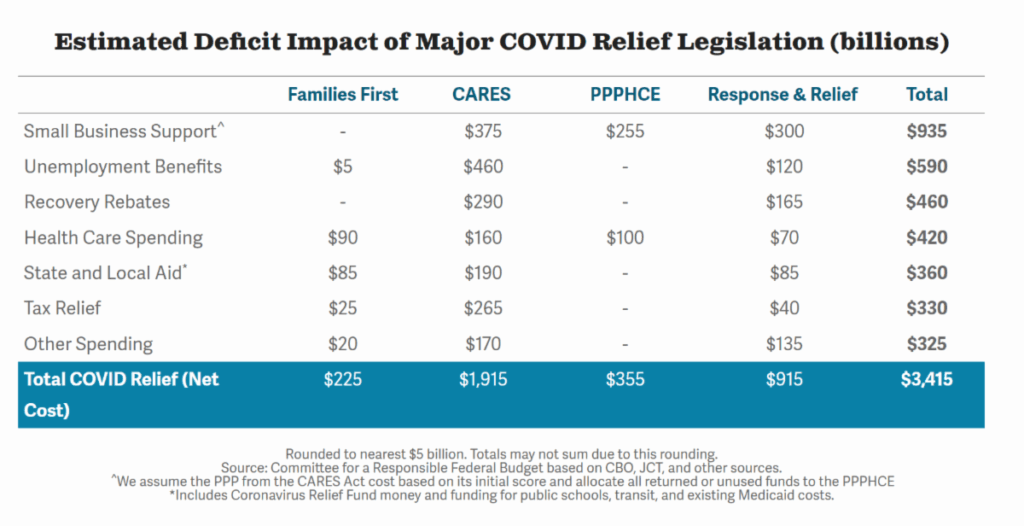
The Financial commitment from our Government for COVID-19 generally refers to the 4 Bills below that total $3.415 Trillion.

March 2020

  • Coronavirus Preparedness and Response Supplemental Appropriations Act $915 Billion
  • Families First Coronavirus Response Act $225 Billion
  • Coronavirus Aid, Relief and Economic Security Act 1.9 Trillion

April 2020

  • Paycheck Protection Program and Health Care Enhancement Act $355 Billion

The breakdown to how this was allocated is listed below in the chart.

Two additional Bills provided some additional funding towards COVID and the Economic Recovery associated with the pandemic a total of $2.8 Trillion.

December 2020

  • Consolidated Appropriations Act, 2021 $2.3 Trillion of which $900 Billion allocated towards Coronavirus funding.

March 2021

  • American Rescue Plan Act of 2021 $1.9 Trillion

The total funding during the 2019/2020 fiscal years totaled $6.2 Trillion for COVID and Economic Recovery.

This type of spending is very unusual, its what we typically would spend during War/Conflicts while Raising Taxes to offset the spending.

Lets have a look at two past examples:

World War II

1939, there was 34 different Federal Income Tax Brackets, but the majority paid zero Federal Income Tax, the top Tax Rate went from 79% to 94% for those with incomes $200,000+, equivalent to 2.5 Million in income today but also very interesting was in 1940 only 7% of our population was paying Federal Income Tax, by 1944 that increased to 64% so a very broadening out of the tax base.

Vietnam War

Revenue and Expenditure Control Act of 1968 was a temporary law put in place for about 18 months, it assessed a 10% surcharge on Income Taxes to Business and Personal Tax.

*research provided by Perplexity AI on the above two items

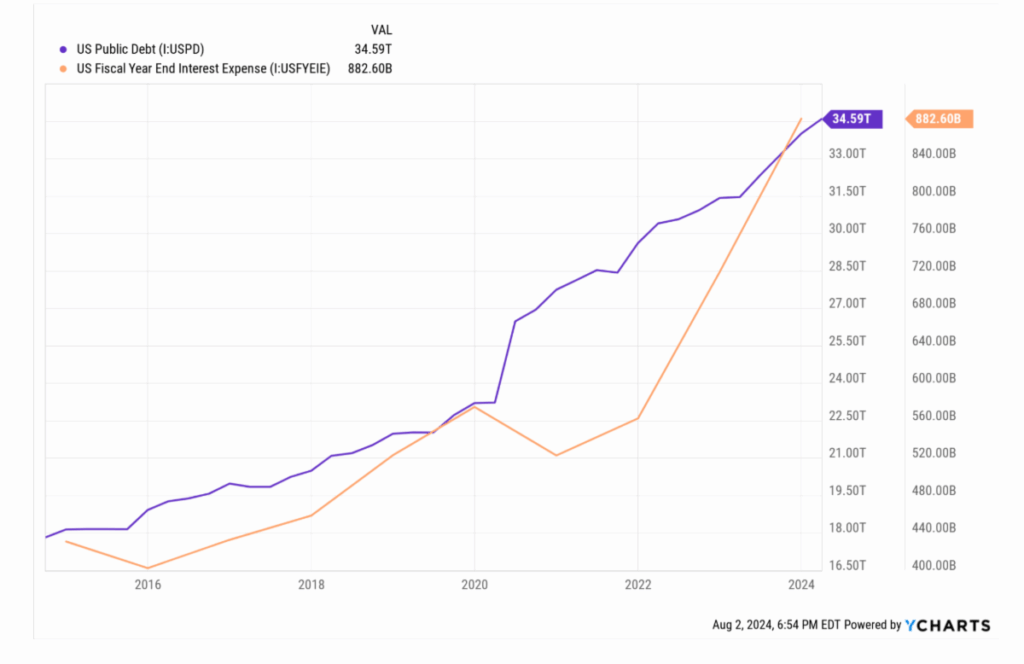
If we look at the chart below, it is showing our debt at 34.59 Trillion and the Interest on this Debt at 882 Billion, there have been a number of recent articles written discussing how our Interest is now over 1 Trillion come the next fiscal year on October 1 2024.

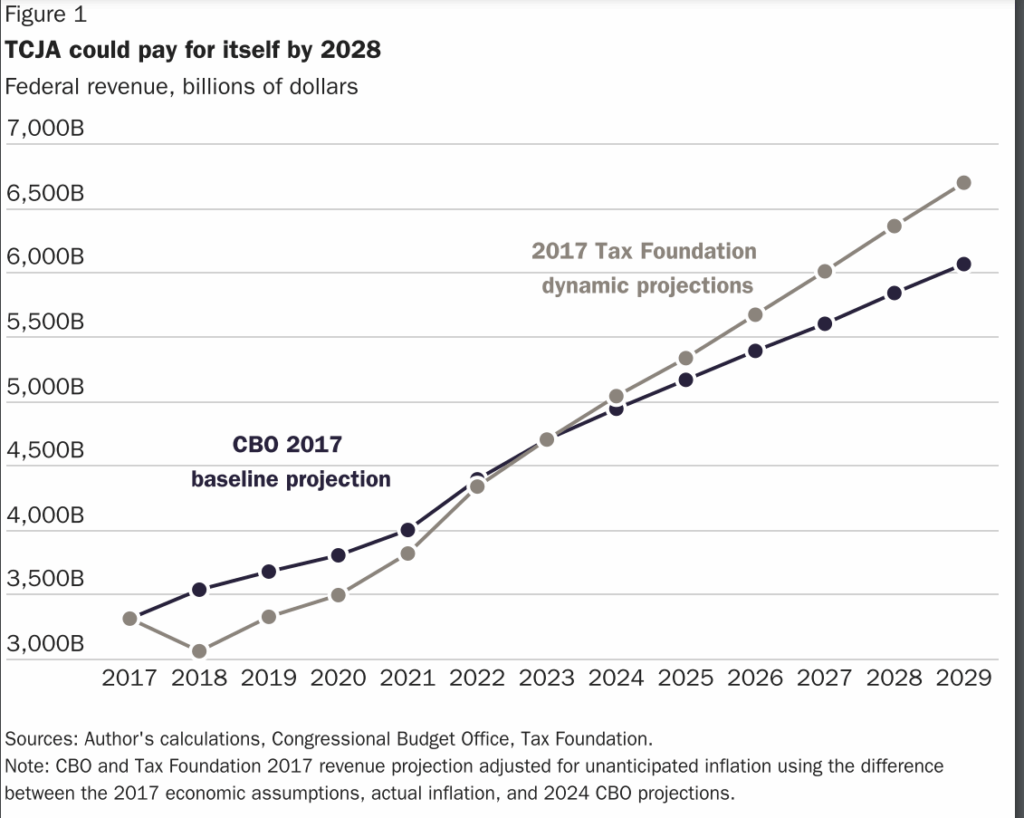
The Tax Cuts and Jobs Act of 2017 which put in place the current tax brackets is set to expire in 2025, the Initial idea of this Act was to lower taxes for both Personal and Business Tax and Increase exemptions like Estate Tax. The total bill was based on “static” accounting with a loss of revenue of about 1.5 Trillion over 10 years, using a more “dynamic” approach to revenue with adding in the investments gained by lowering taxes it shows the bill paying for itself 2024/2025 time period.

However since COVID Recovery and Economic Stimulus has blown a large hole in the budget, the current tax law expiring its safe to say Taxes will be going up, and broadening out as it has in the past.

Currently, a Married couple with 2 kids and total income of about $75,000 zero federal income tax, $90,000 would have income tax rate at about 6%, if Income was at $125,000 a tax rate of about 12% and I would anticipate Income Tax going up for all starting in 2026 regardless of who wins the Presidency this year.

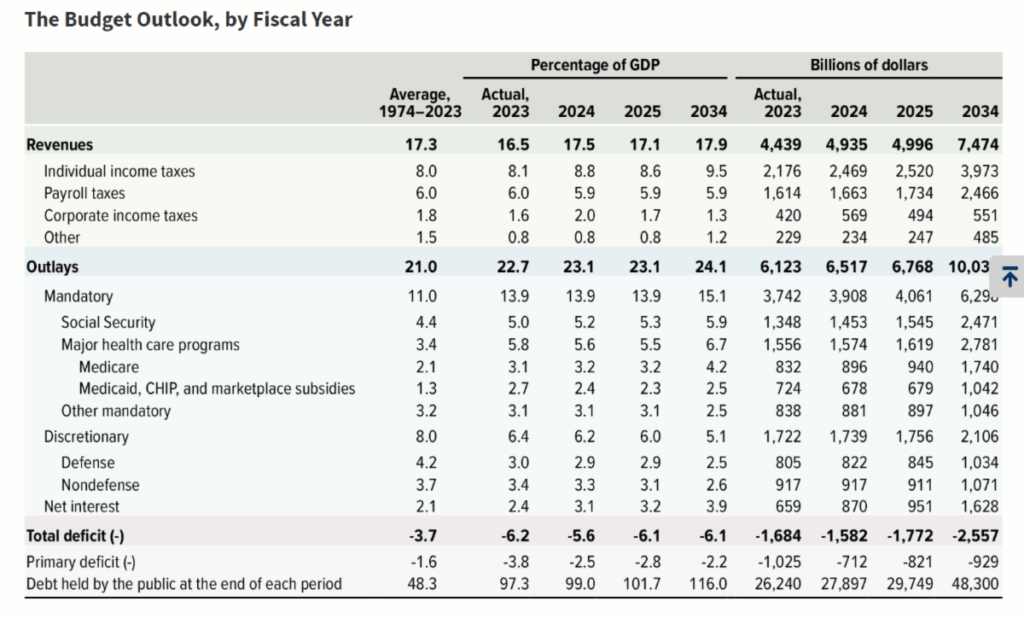
In looking at the Budget below, it shows total revenue of about 4.9 Trillion for fiscal year starting October 1st 2024, and with anticipate Interest on our Debt at 1 Trillion that is about 20% of our total Revenue. This is why preparing for higher taxes should be considered and discussion around saving tax deferred, Estate Tax planning important and we can run the numbers and discuss strategy at any time.

With our Government spending at about 6.5 Trillion, and our Tax Revenue at about 5 Trillion, I would anticipate an increase of about 2.2 Trillion in Tax increases over the next cycle and with solid leadership a real scrutiny on spending, and lowering the interest rates while extending out maturities on the debt.

Thank you for reading and as always, if you have any questions please reach out, enjoy the balance of summer.